 Spin Wheel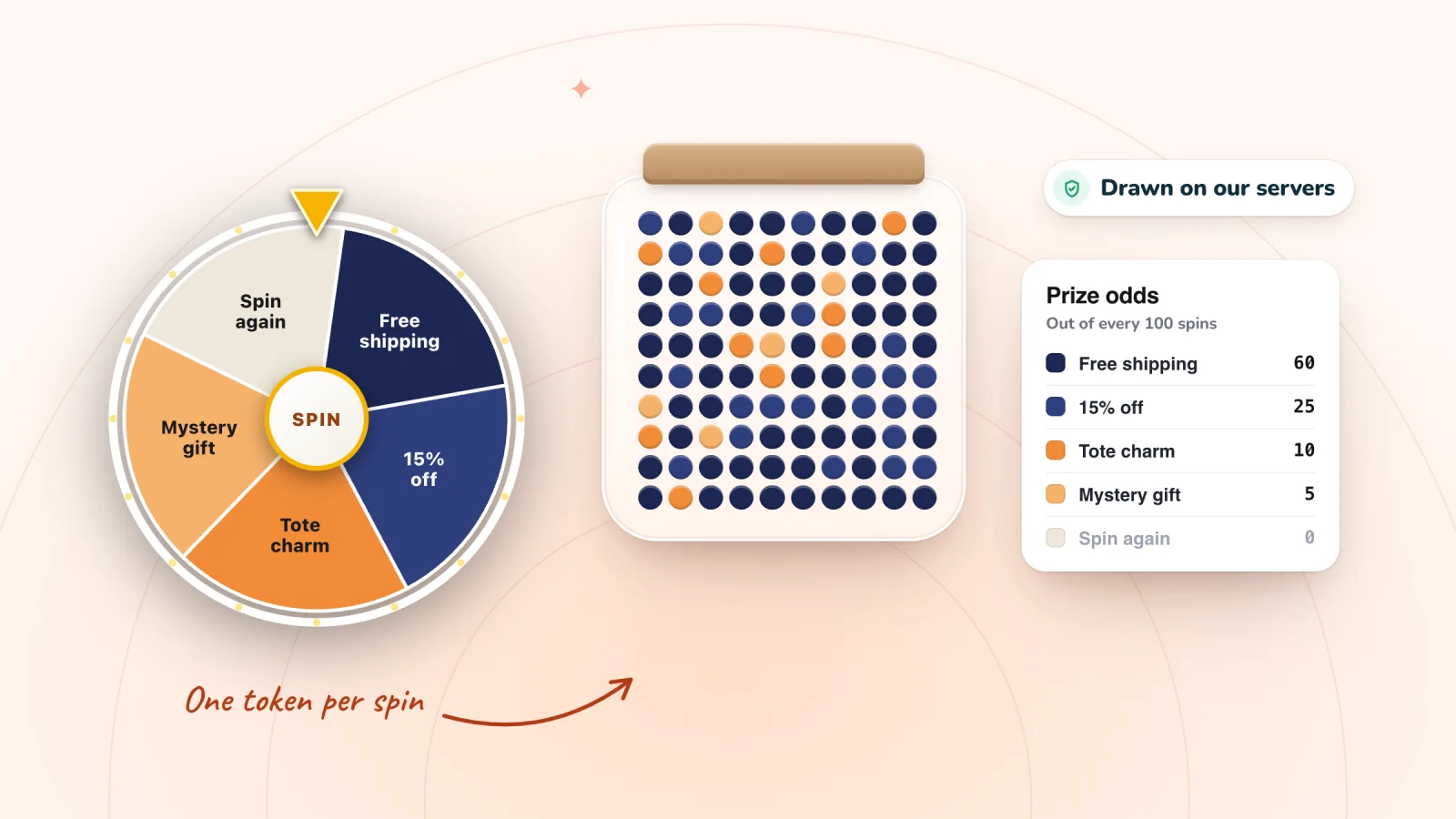
On this page
Every spin wheel has odds, whether you choose them on purpose or not. The odds decide how often each prize comes up, what the game costs you, and whether shoppers believe the wheel is real. This guide explains how odds work, where the draw should happen, and how to set and check them with care.
Key takeaways
- Set each prize's chance separately from its slice size, and make sure all the chances add up to 100.
- Draw the prize on a server, not in the shopper's browser, so nobody can read or change your odds.
- Make your most common prize cheap and welcome, and keep the headline prize rare but real, around one or two in 100.
- Judge your split after a few hundred spins, and if costs run high, lower the chance of the priciest prize first.
How spin wheel odds work
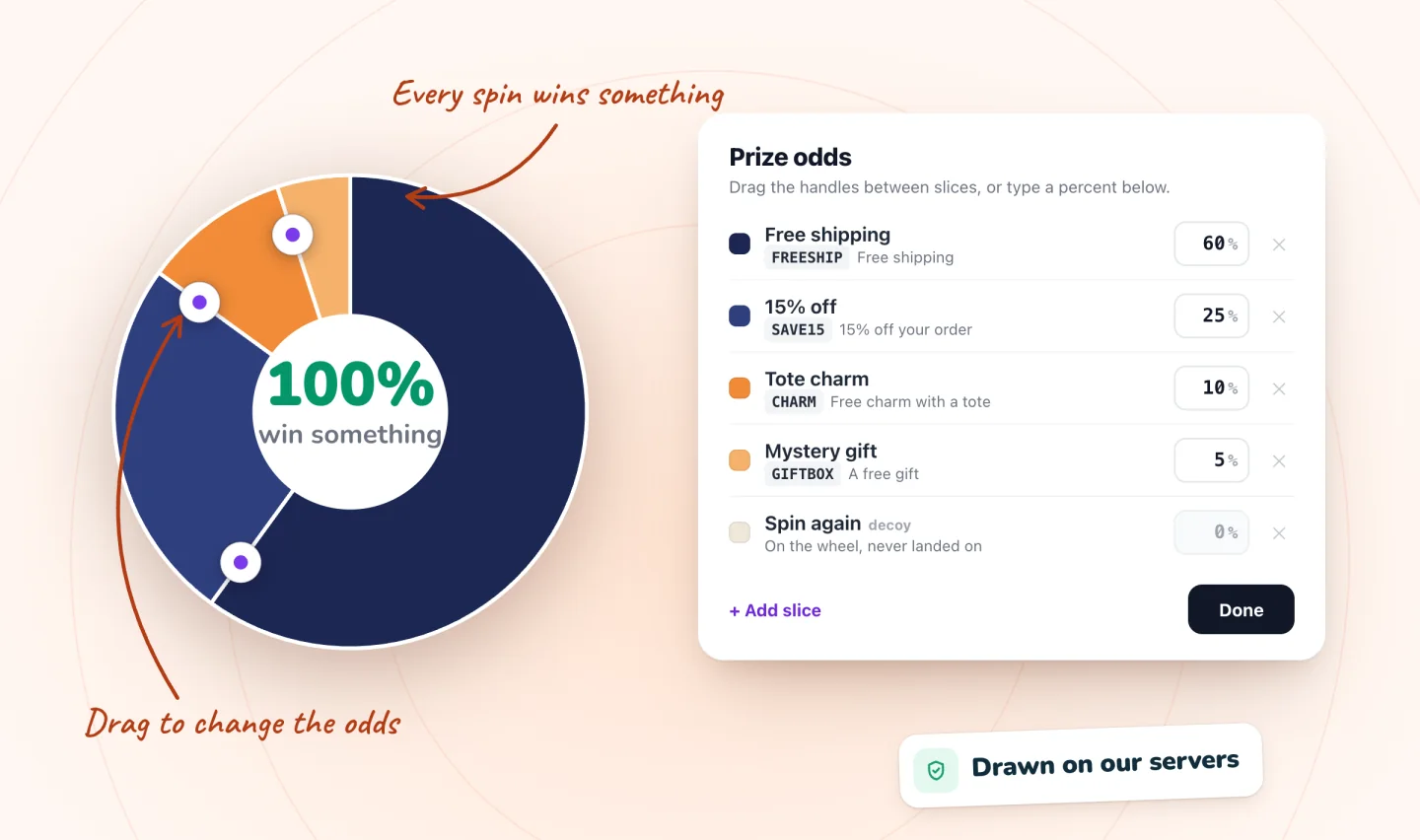
Each prize on a wheel has a chance of being picked. Together, the chances cover every spin, so they add up to 100 out of 100.
Picture a bag of 100 tokens. Say 35 tokens read "free shipping," 30 read "10% off," and 1 reads "free product." Each spin pulls one token at random and then puts it back. Over many spins, free shipping comes up about 35 times in every 100, and the free product about once.
Three things follow from this:
- A slice's size and its chance are separate. Wheels usually draw every slice the same size because it looks tidy. The chance behind each slice is set on its own.
- Each spin starts fresh. The wheel has no memory. A prize with a 1 in 100 chance can come up twice in a row, or not at all for a few hundred spins.
- Small numbers wobble. Over 20 spins, the results can look nothing like your settings. Over a few hundred, they settle much closer.
Why the draw belongs on a server
Something has to pull the token from the bag. That can happen in the shopper's browser or on a server the shopper can't touch. Of all the choices behind a wheel, this one matters most for trust.
The problem with drawing in the browser
When the browser picks the prize, the chances and the prize list sit in code that anyone can open with the browser's developer tools. A curious shopper can read your odds. A determined one can change them, or skip the spin and ask for the headline prize directly. Once someone works out a trick like that, they can share it.
What a server-side draw changes
With a server draw, the browser only asks for a result. The server picks the prize using the chances you set and sends back the answer, and the wheel's animation slows down to land on that slice. Nobody can rewrite the odds from their own browser, and the logic stays out of reach.
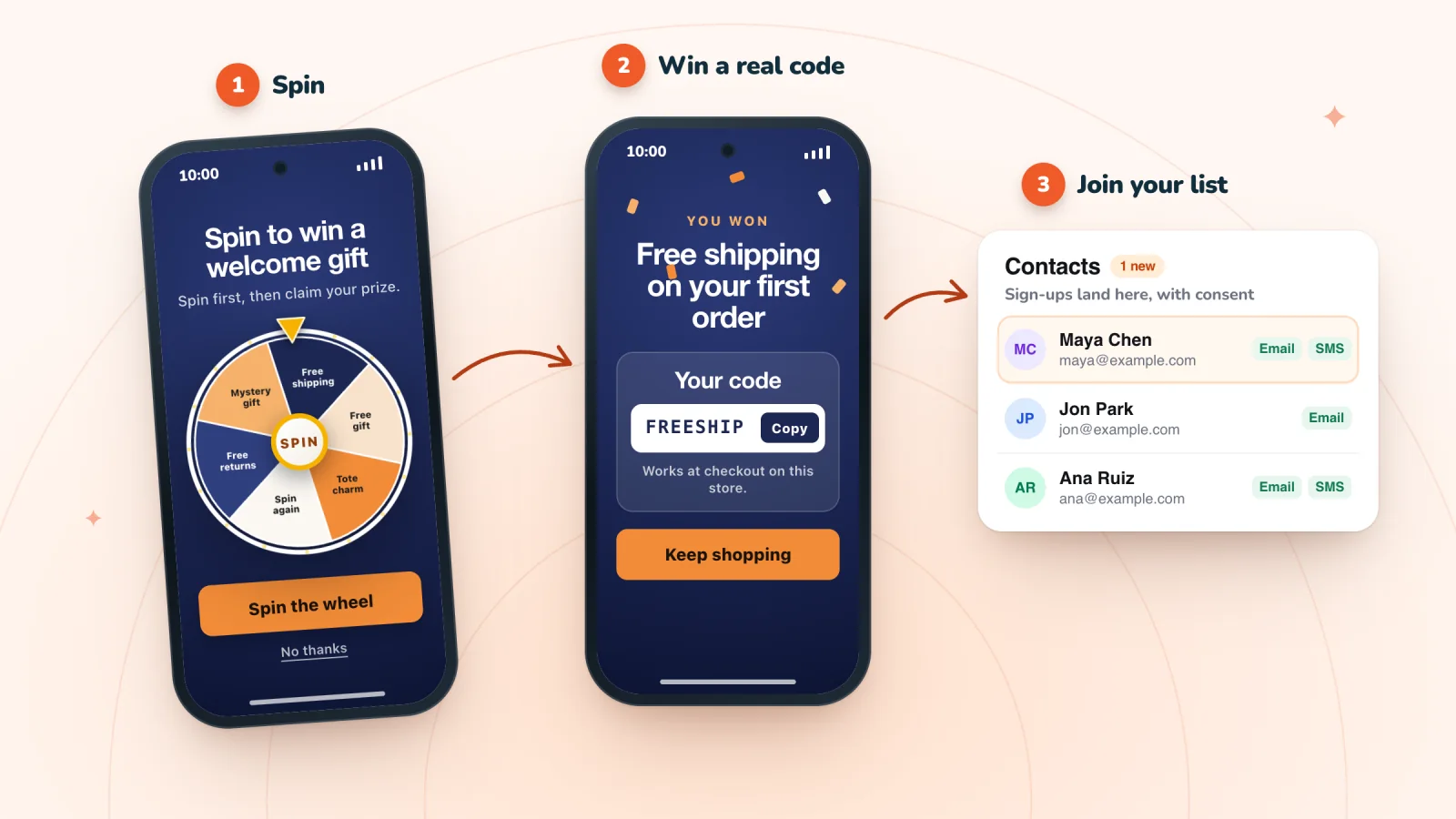
This protects your word, too. When the draw can't be tampered with, the odds you set really are the odds every shopper gets. For more on how a drawn prize turns into a code, see coupon pop-ups.
Keep every outcome a prize
Odds work best when every slice that can come up is a real prize. If a shopper gives you an email address to play and can walk away with nothing, the game starts to look like a game of chance. When every result is a prize of some size, it stays a simple tiered offer.
Variety then comes from prize value, with a common everyday prize, a mid prize or two, and a rare headline prize. Decorative slices such as "So close!" can sit on the wheel for looks, as long as their chance is zero and they never come up.
Put a spin-to-win pop-up on your store
AI designs it from your brand, every spin wins a real coupon, and sign-ups land in your contacts. Free for one pop-up.
Add to Wix, it's free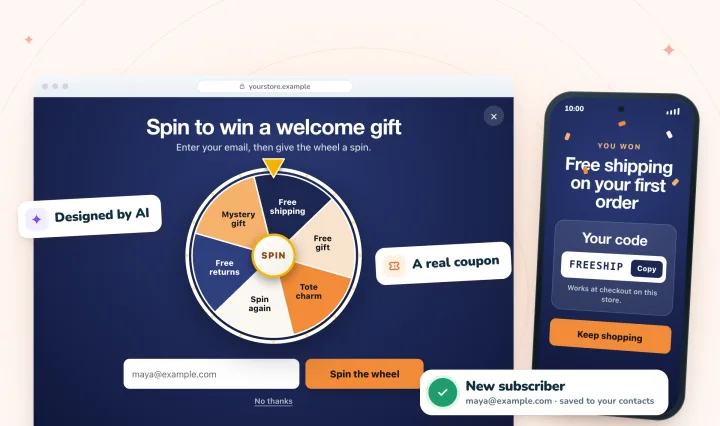
Sensible splits for a six-slice wheel
There is no single right split. These three examples use the same six prizes, with chances out of 100.
| Prize | Generous | Balanced | Careful |
|---|---|---|---|
| Free sample | 20 | 20 | 22 |
| 10% off | 30 | 30 | 30 |
| Free shipping | 30 | 35 | 40 |
| $10 off orders over $60 | 10 | 8 | 5 |
| 20% off | 8 | 5 | 2 |
| Free full-size product | 2 | 2 | 1 |
A few rules hold whichever column you start from:
- Make the most common prize one you're glad to give. More winners get it than any other prize, so it should be cheap for you and still feel like a win.
- Keep the headline prize rare and real. One or two in 100 protects your margin, and it's frequent enough that people do win it.
- Let the middle do the work. Mid prizes give a spin its sense of possibility without the cost of the headline prize.
- Price the mix before launch. The guide to spin wheel prize ideas shows how to turn a split into an average cost per order.
Be honest with shoppers
Trust is the whole point of a game. A few habits keep it intact.
- Make every prize on the wheel winnable. A prize slice with no chance of coming up is a fake prize. If you don't want to give something away, take it off the wheel.
- Make the result match the wheel. The slice the wheel stops on should be exactly the prize the shopper receives, with the same name and terms.
- Say that chances differ. A short line in small print, such as "Prizes have different chances of winning," is a simple courtesy.
- Publish the terms. State who can play, what each prize covers and when codes expire, on a short page linked from the pop-up.
- Answer questions plainly. If someone asks about the odds, tell them.
Check the results after launch
Setting odds is half the job. Checking them is the other half.
- Write down what you expect. Before launch, note each prize's chance, the average cost per order, and how many extra orders that cost requires. A tool that works out a discount's break-even point helps with the last part.
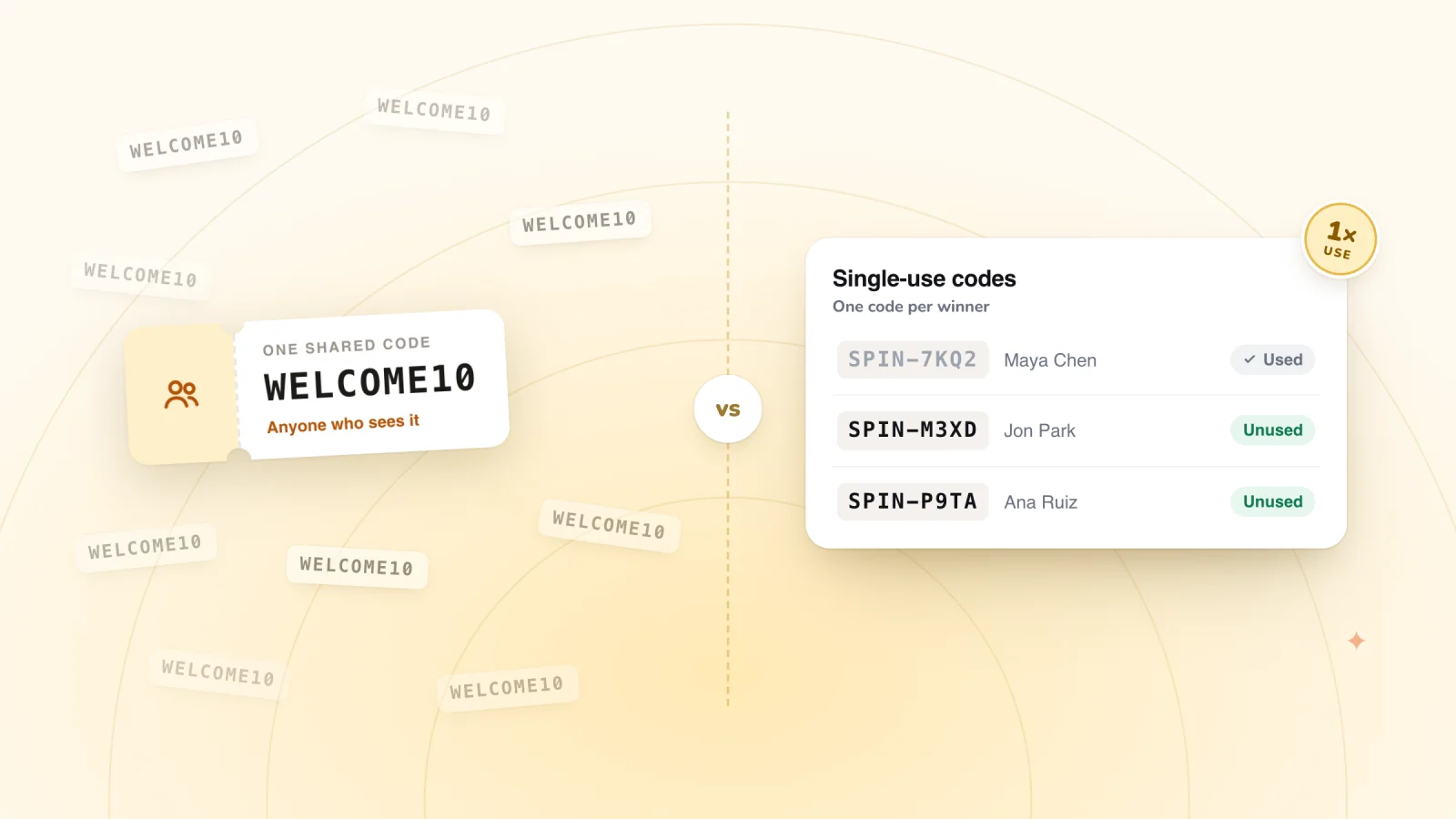
- Give each prize its own coupon. Then every order that uses a code tells you which prize it came from. The guide to unique coupon codes covers how to keep those codes from spreading.
- Give it time. Judge the split after a few hundred spins. Early results drift around your settings, and that's normal.
- Compare prizes given with prizes used. A prize that winners rarely use at checkout isn't earning its slot. Swap it for something people want.
- Recheck the cost. After the first month, compare what the prizes actually cost with the average you expected. If it runs high, lower the chance of the priciest prize first.
Frequently asked questions
What makes a spin wheel fair?
A fair wheel follows the chances the store sets, every prize on it can really be won, and the slice it lands on is exactly the prize the shopper gets. The draw should happen where nobody can change it, such as on a server. Spin Wheel draws every prize on its servers from the odds you set, and the shopper's browser only plays the animation.
How do you work out spin wheel probability?
Divide each prize's chance by the total of all the chances. When the chances add up to 100, a prize set to 20 comes up about 20 times in every 100 spins over the long run. To estimate how many of a prize you'll give away, multiply its share by the spins you expect. At 20 in 100, a thousand spins means about 200 of that prize.
Why don't my spin wheel results match the odds I set?
Usually because there haven't been enough spins yet. Results drift around your settings by chance, and a few dozen plays aren't enough to judge. Wait for a few hundred spins before you judge. If the gap is still large, check that the chances you saved are the ones you meant.
Do you have to publish the odds for a spin-to-win game?
It depends on where you sell and how the promotion is set up, so check the local rules. Even where it isn't required, a short note that prizes have different chances, with a link to terms that list each prize, helps shoppers trust the game. This is general information, not legal advice. Take extra care if you offer a valuable headline prize.
Try it on your store
Spin Wheel draws every prize on myuser.ai's servers using the chance you set for each one, so the odds you choose are the odds shoppers get. See the wheel on the spin-to-win pop-up page.

We build marketing apps for online stores: myuser.ai writes and sends emails and texts from a store's own products, and we make Spin Wheel and Session Recordings for Wix sites. Product details in our guides are checked against the apps themselves.