 Spin Wheel
On this page
The prizes on your wheel decide whether shoppers want to play and how much each game costs you. A wheel packed with big discounts gets attention and quietly eats your margin. This guide shows how to price every slice, then offers sample prize mixes for five kinds of stores.
Key takeaways
- Price each prize by what it costs you on a typical order, not by the number shown on the slice.
- Multiply each prize's cost by its chance and add the results to find the average cost per order that uses a prize.
- Build each mix in three levels: a common everyday prize, a couple of mid prizes and one rare headline prize.
- Make every outcome a real prize, and keep slice labels to two or three words that match the coupon name.
Price each prize by what it costs you
The number on a slice is rarely what it costs you. A prize only costs money when someone uses it on an order, and each type of prize costs something different.
- Percent off. The cost grows with the cart. Ten percent off a $40 order costs $4, and the same prize on a $200 order costs $20.
- Dollar off. The cost is fixed, which makes it easy to plan around.
- Free shipping. The cost is what you pay the carrier for that order, which may be more or less than you usually charge. If orders over a set amount already ship free, the prize only matters below that line, as the guide to free shipping thresholds explains.
- Free gift. The cost is what the item costs you to make or buy, plus packing. A gift that sells for $12 might cost you $3.
- Sample. Often the cheapest prize to give, and it introduces a second product.
- Add-on. Gift wrap, a handwritten note or engraving costs you time and materials, often very little.
A worked example
Say you sell candles at $28, and a typical order comes to $45. Shipping costs you about $7 an order, a mini candle costs you $3 to make, and a wax melt sample costs you $1.
| Prize | Cost to you on a $45 order |
|---|---|
| Wax melt sample | $1.00 |
| Free mini candle | $3.00 |
| 10% off | $4.50 |
| $5 off | $5.00 |
| Free shipping | $7.00 |
| 20% off | $9.00 |
Free shipping looks modest on the wheel, yet here it costs more than every prize except 20% off. The sample and the mini candle look generous and cost the least. That gap is where your margin hides.
Work out the cost of the whole wheel
Once you know each prize's cost, weight it by how often it comes up. Multiply each prize's cost by its chance, then add the results. That gives you the average cost of a prize that gets used.
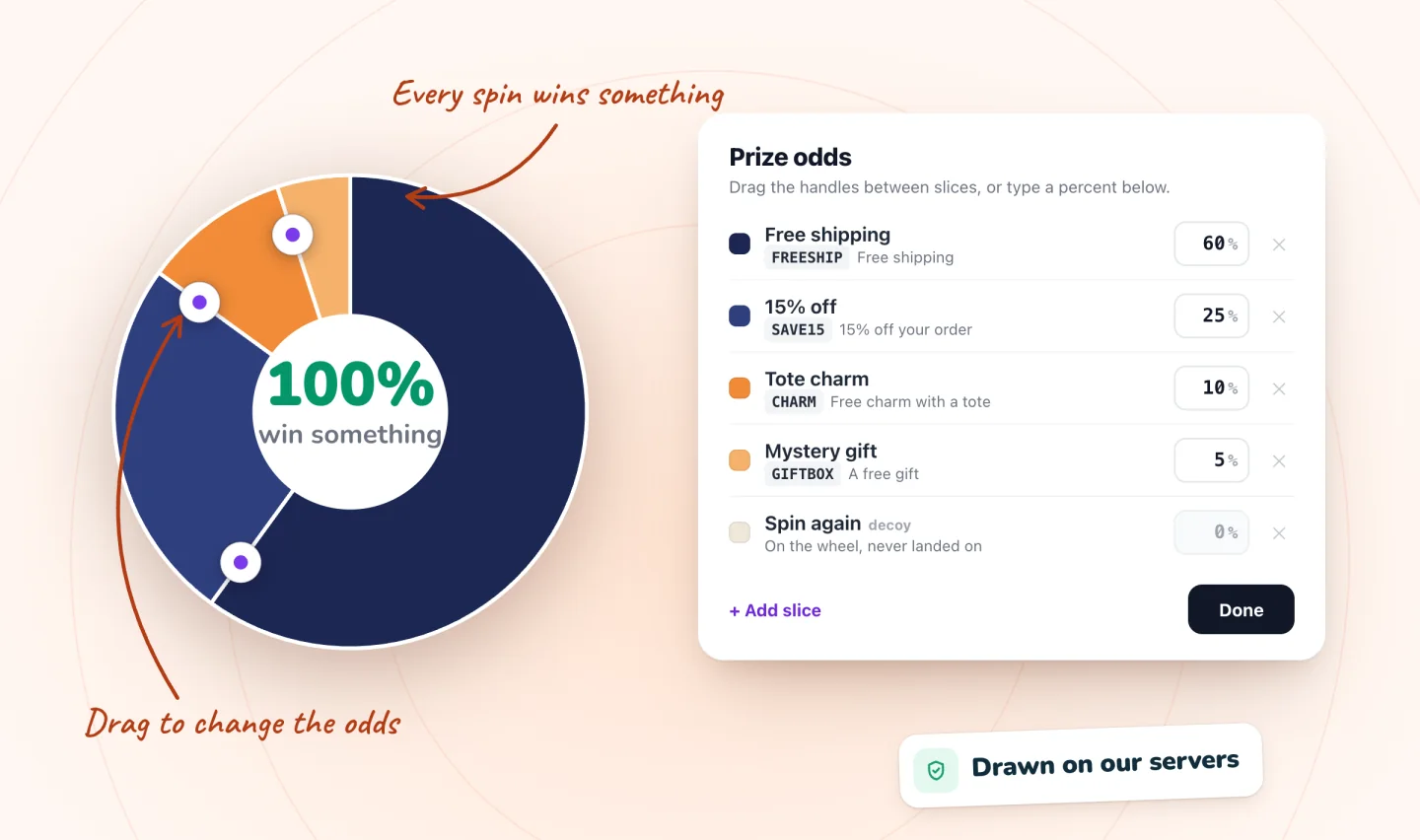
Using the candle numbers, suppose you set these chances out of 100 spins:
- Free shipping: 30 in 100, so 0.30 × $7.00 = $2.10
- Wax melt sample: 25 in 100, so 0.25 × $1.00 = $0.25
- 10% off: 20 in 100, so 0.20 × $4.50 = $0.90
- Free mini candle: 15 in 100, so 0.15 × $3.00 = $0.45
- $5 off: 5 in 100, so 0.05 × $5.00 = $0.25
- 20% off: 5 in 100, so 0.05 × $9.00 = $0.45
Add them up and the average prize costs $4.40 on each order that uses one. If a typical order leaves you $24 after the cost of the candles, the prize still leaves you about $19.60.
The harder question is how many extra orders the wheel needs to bring in to pay for itself. A break-even calculator from myuser.ai does that math in a minute. How to choose the chances in the first place is a topic of its own, covered in the guide to spin wheel odds.
Put a spin-to-win pop-up on your store
AI designs it from your brand, every spin wins a real coupon, and sign-ups land in your contacts. Free for one pop-up.
Add to Wix, it's free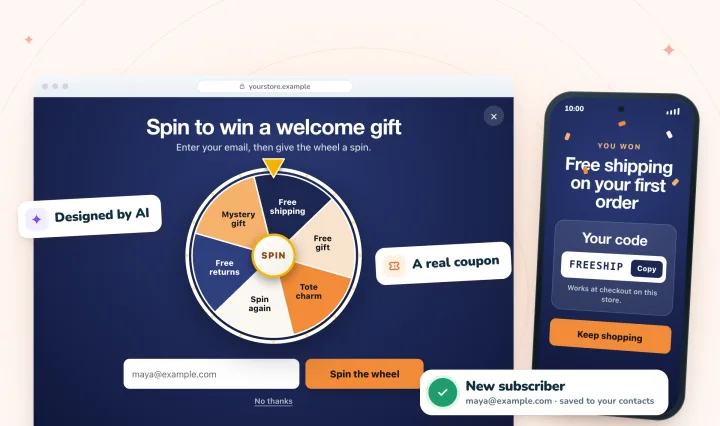
Prize mixes for five kinds of stores
These are starting points. Check that each prize can be set up as a coupon in your store, since a coupon is what a coupon pop-up hands out. Swap in your own products and costs, and give each mix three levels, with a common everyday prize, a couple of mid prizes and one rare headline prize. If you'd rather show one welcome offer with no game, the guide to welcome discount ideas beyond 10% off has options.
Fashion and accessories
Free shipping, 10% off, $10 off orders over $75, a free accessory with any order (socks, a hair tie, a tote) and a rare 20% off as the headline prize. A free accessory adds something to the parcel without cutting the price of the main item.
Beauty and skin care
Deluxe samples, a free travel-size product, free shipping, $5 off and a rare full-size product as the headline prize. Samples do double duty here, since a shopper who likes one has a reason to come back for the full size.
Food, coffee and treats
A free sample pack, an extra bag or bar with the order, $5 off, and free shipping only if your parcels are light. Chilled or heavy parcels can push the cost of free shipping well above the other prizes, so price it before it goes on the wheel.
Handmade and small-batch goods
Free gift wrap, a free personalized note, a small extra piece, $5 off and free shipping. Add-ons suit handmade shops because they cost you time more than money, and they show off the care that goes into each order.
Higher-priced products
For items over $150 or so, percent-off prizes get expensive fast. Fixed dollar amounts with a minimum order, a free accessory or free shipping hold their value without denting the price of the main item.
Make every slice a prize
Every outcome on your wheel should be a prize. When a shopper hands over an email address to play, a game they can lose starts to look like a game of chance. Making every outcome a prize keeps it a simple tiered offer. Everyone gets something, and some people get something better.
It also keeps the moment pleasant. A shopper who trades an email address for a real prize starts out on good terms with your store.
Variety comes from prize value. A common everyday prize, a mid prize or two and a rare headline prize give the wheel its excitement. If you need a prize that costs next to nothing, a sample or free gift wrap fills that role.
Some wheels show "So close!" or "Spin again" slices as decoration. They work only as decoys that never come up, so every spin still lands on a real prize.
Write slice labels people can read at a glance
- Keep each label to two or three words. "Free shipping," "10% off" and "Free mini candle" can be read while the wheel turns.
- Name the actual thing. "Surprise prize" sounds fun but tells the shopper nothing about its value.
- Skip shorthand. Abbreviations like "FS" or "BOGO" can puzzle a first-time visitor.
- Use the same words everywhere. Match the label on the wheel, the win screen and the coupon's name in your store, so nothing looks different at checkout.
Frequently asked questions
What should you put on a spin wheel?
Put prizes your shoppers would be glad to win and you can afford to give. Good choices include free shipping, a small dollar or percent discount, a free sample or gift, and add-ons such as gift wrap. Aim for a spread, from a cheap everyday prize to one rare headline prize, and make sure each one can be set up as a coupon in your store.
How big should a spin wheel discount be?
Big enough to feel like a win, and small enough to leave a profit on a typical order. Work out what each discount costs on that order, then check the average cost across the whole wheel. Keep the biggest discount rare, and consider a fixed dollar amount with a minimum order, since its cost stays the same however large the cart gets.
What are good low-cost prizes for a spin wheel?
Samples, travel sizes, free gift wrap and handwritten notes tend to cost the least while still feeling generous. A sample doubles as an introduction to something else you sell, and gift wrap or a note mostly costs you a few minutes. Before adding any prize, check what it costs you on a typical order, including any packing.
Should spin wheel prizes expire?
Yes, in most cases. An end date gives shoppers a gentle reason to use the code while your store is on their mind, and it keeps old codes from turning up after your prices change. One to two weeks is a reasonable window for a welcome prize. In Spin Wheel, shoppers have 24 hours by default to claim a prize they revealed, and you can change that window.
Try it on your store
In Spin Wheel, every prize is a real coupon from your store, and you choose the chance for each one. Every spin wins a prize, and any decoy slices you add never come up. See the wheel on the spin-to-win pop-up page.

We build marketing apps for online stores: myuser.ai writes and sends emails and texts from a store's own products, and we make Spin Wheel and Session Recordings for Wix sites. Product details in our guides are checked against the apps themselves.